
How to Turn the Videos You Already Have Into a Paid Program (A Realistic Timeline)
Published: October 17th, 2026 · Updated: November 5th, 2026
Short answer
Often, yes, you can build a paid program from content you already have. But having videos is not the same as having a program. A focused first version, with a clear promise and a lower price, can take around five weeks. A premium program, one that buyers pay a lot for, usually takes longer, because those buyers expect structure, quality and support that a repackaged playlist does not provide.
The honest timeline depends on how much of your content is usable, what you plan to charge and how much new material has to be made. The plan below shows the steps; we scope the timeline case by case.
Why having the videos is not the same as having a program
You may have hundreds of videos on YouTube and still not have anything people would pay for. Free content and a paid program solve different problems:
- Free content is scattered. It follows what you felt like making that week, in no particular order.
- A program follows a path. It takes someone from a specific starting point to a specific result, step by step.
- Public videos may be outdated or aimed at a different audience. Something recorded two years ago for beginners may not fit a program for people who are further along.
- Paid buyers expect more. People paying for a program expect order, worksheets, next steps and often some form of support or feedback. The higher the price, the higher the expectation.
That is why the work is mostly selection, structure and gaps, not just collecting links. And it is why the answer to "do I need to record anything?" is usually "probably some."
The five-week map
Here is the path for a focused first version. Week by week, one outcome each.
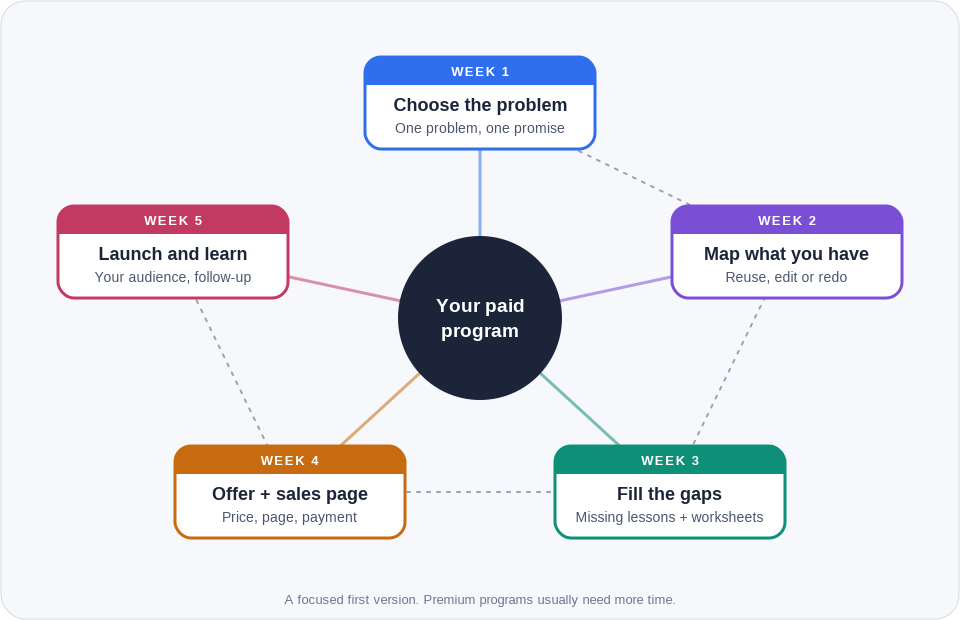
If you prefer to read it as a list:
- Week 1: Choose the problem and the promise. One problem, one outcome, one sentence: "After this program, you will be able to ___."
- Week 2: Map what you already have. List the videos, posts and lives that cover the problem. Sort them into steps. Mark what is missing, what is outdated and what needs to be redone.
- Week 3: Fill the gaps and build the structure. Record or write the missing pieces. Add a worksheet or action step to each module.
- Week 4: Build the offer and the sales page. Price, what is included, the sales page, the payment setup and the delivery.
- Week 5: Launch and learn. A short launch to your own audience, personal follow-up and a review of what worked.
Week 1: Find the one problem
Review your most-viewed videos and the questions in your comments and DMs. Choose one problem and one outcome. If you need help choosing, this guide shows how to turn your audience's questions into a product idea.
Week 2: Map your existing content
For each video, note three things: does it answer the problem, is it still accurate, and is the quality good enough to charge for? Then sort the videos into three piles: use as is, use after editing, and redo. Many creators find that part of their content is genuinely reusable and that another part is not.
Week 3: Fill the gaps and build the structure
Create what is missing and put everything in order. Keep it short. A tight program that gets a result is worth more than a long one.
Week 4: Build the offer and the sales page
Write the sales page, set the price and spell out what is included. Prepare a short sales script or video. Set up payment and delivery so a buyer gets access immediately.
Week 5: Launch
Run a short sequence to your audience: useful content, proof, answers to objections and a clear invitation to join. Follow up personally with people who show interest.
How long will it really take?
Five weeks is a realistic plan for a focused first version. It is not a promise, because several things move it:
| What changes the timeline | Shorter | Longer |
|---|---|---|
| How much usable material you have | A lot of clear, up-to-date videos on one topic | Scattered, outdated or off-topic content |
| Price point and expectations | Lower-priced, focused program | Premium or high-ticket program |
| How much has to be recorded | A few missing lessons | Most of the program |
| How quickly you can review and approve | Fast feedback | Delays between decisions |
| How the program is sold | Self-serve sales page | Sales conversations and application calls |
For example, a creator in a niche like real estate coaching, where programs are expensive and buyers expect depth, will usually need more than five weeks. Even if every tip is already on YouTube, a premium program has to be organized, completed and polished to a standard people will pay a lot for. We would rather tell you that up front than promise a date and miss it.
What to measure
After the launch, look at: how many people clicked, how many asked questions, how many bought and which objections came up. Use that to improve the next version.
What if you know the subject, but don't know where to start?
Many creators have the knowledge and even the content, and still feel stuck because they have never built a program before. They do not know how to structure it, what to price it at or how to launch it.
That is the work an operator does for you: sharpening the offer, writing the pages, setting up the follow-up and running the launch, while you keep creating and approve what goes out. In our case it is done on a revenue share, so the offer, funnel and launch are handled for you. You bring the expertise. A growth partner brings the process.
Frequently asked questions
- Do I have to record everything again?
- Probably some of it, yes. Existing content can often be reused and reorganized, and old videos are valuable for examples, stories and proof. But most programs also need new material for the gaps, a clearer order and a consistent quality. How much depends on your content and on what you plan to charge.
- Can I charge premium prices for content that is free on YouTube?
- Yes, people pay for programs whose material is partly free, but they pay for what the free content does not give them: structure, a complete path, a result, support and accountability. A repackaged playlist will not support a premium price. A well-built program can.
- How long should the program be?
- As short as it can be while still delivering the promised result.
- What if nobody buys?
- You learn why: wrong problem, wrong promise or wrong audience. That information is still useful for the next version. It is also why we start with a short launch to your own audience instead of a large build.
- How much does it cost to have someone do this for me?
- Most operators are paid a share of the revenue instead of an upfront fee. At Backbeat Operators it is typically 20% to 40%, agreed in writing before work starts. Depending on the project, there may also be a one-time setup fee, agreed in writing. Read Agency or Revenue-Share Partner to compare it with hiring an agency.